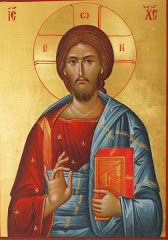
From the Lenten Devotional, Sacred Space.
Jesus excited curiosity so that people like Zacchaeus and Greek visitors to the festival wanted to see him, to know what he looked like.
But Jesus had other ideas, confronting and revolutionary ideas. To "see" him was to enter totally into his way of thinking, to understand why he had to suffer and die and rise again. Like the grain of wheat, Jesus has to let go of everything, including his own life, in order to bring life. This is the "emptying", the kenosis, that the Letter to the Philippians speaks about. In the process, Jesus and we will be transformed, just as the grain of wheat, apparently annihilated, becomes something altogether greater and enriching for others.
Are we ready for that? Are we afraid to let everything go? Is Jesus asking too much? Lead us to see and accept this as the core of Jesus' life, so that we really see him.
Wednesday, April 1, 2009

Tuesday, March 24, 2009
The Sense of God's Love
This week's Lenten thought from Sacred Space.
"Then he came to his senses." This deceptively simple statement about the prodigal son poses a profound challenge to us all. None of us can claim to be without sin. "We all fall short of the glory of God." Lent can be that moment in which we come to our senses, face facts about ourselves, and make the appropriate adjustments.
After a brief romantic affair with threatened to destroy his marriage and alienate his family and friends, John came to his senses. Before matters got worse, he had the courage to face his fault, admit his sin, and turn back. He was fortunate to receive his wife's understanding, love and forgiveness.
During Lent we turn back to God and entrust ourselves once again to his immense mercy. We allow the Father to embrace us in our sinfulness and sorrow. In being forgiven much, we discover the depths of God's love.
Wednesday, March 11, 2009
The Lord's Prayer
Our church is really focusing on the meaning of Lent. Its a time to evaluate our lives and be reminded of our dependence on God for everything.
This past Sunday I preached a sermon about what is commonly known as, The Lord's Prayer. I guess it could also be known as The Disciple's Prayer because it was a prayer that Jesus used to instruct his followers to pray. One of the things that I wanted to stress is that this prayer wasn't given as a formula just to recite over and over, but it was given to influence the content of prayer.
During the latter part of my preaching of this sermon I led the congregation in praying through this prayer. As I was doing this I began to be gripped by the power of what I was praying and I became very emotional. It was very hard to contain myself and I am sure I was quite the spectacle, but it didn't matter to me. In that moment I just wanted the congregation to sense how great our Heavenly Father is and how transformational his love and forgiveness can be in our lives.
Knowing him impacts everything. It impacts our values and decisions. It impacts the way we receive from him and the way we relate to others. I will never read or pray this prayer the same way again.
You can listen if you wanna. Go to PRAYER.
Wednesday, March 4, 2009
Prayer for Essentials RED
For: The Institute of Contemporary and Emerging Worship Studies, St. Stephens University, Essentials Red Online Worship History Course with Dan Wilt.
Prayer, for me, is wonderfully frustrating. There are times when it seems easy and I feel connected to God while at other times I feel like I am wading through peanut butter. I have been a Christian for a while, so you would think that I have a handle on prayer, right? More than that, I am a pastor, a professional. This should be easy. Wrong. Sometimes prayer is hard work. At least it is for me.
One of the things that I have learned about myself is that I need some sort of structure. Some time ago I looked at how our early church fathers and mothers handled prayer. It seems as if they needed some structure, too. They scheduled prayer into their days. So, I have done this myself. As I schedule my days, I try to schedule a time for prayer. I use a devotional book, The Little Book of Hours, from the Benedictine monks. It has helped me immensely by helping me to become focused. My mind tends to wander.
I am very grateful for this structure. I try not to just go through the motions. I try to keep my focus on God’s presence in my life and envision him listening and watching me. I am seeking his face.
This has got be to thinking about prayer as it relates to our worshiping community. In our services, we are relying a little more on written prayers that we pray out loud together. I love this because it reminds me that I not only have a “personal” prayer life, but I also have a communal pray life, too.
Also related to prayer and our church community, I am tinkering around with the idea of a midweek prayer time during the lunch hour. It would be short (30 min) where some of us could meet up and be led through some readings and prayer. Just a thought. Haven’t talked to anyone, yet. We’ll see.
Below is one of my favorite “written prayers” by St. Patrick. I love it.
“Christ beside me, Christ before me;
Christ behind me, Christ within me;
Christ beneath me, Christ above me;
Christ to right of me, Christ to left of me;
Christ in my lying, my sitting, my rising;
Christ in heart of all who know me,
Christ on tongue of all who meet me,
Christ in eye of all who see me,
Christ in ear of all who hear me.
For to the Lord belongs salvation,
And to the Lord belongs salvation
And to Christ belongs Salvation.
May your salvation, Lord, be with us always.
Friday, February 20, 2009
Time and Space for Essentials RED
For: The Institute of Contemporary and Emerging Worship Studies, St. Stephens University, Essentials Red Online Worship History Course with Dan Wilt.
One of the ideas that we have been asked to focus on during this section of learning is "remember" as it relates to time and space. I believe this is one of the most important things we can do as followers and worshipers of Jesus. The reason it is so important is that we have a tendency to forget what God has done and is going to do. People in our culture seem to be driven by the question 'What have you done for me lately?' Sadly, church folks seem to ask God this question, too. When life gets difficult or we don't 'feel' God's presence or things aren't as easy as we like there is the temptation to doubt God... to doubt his love or care. There is the temptation to believe that he is distant or tending to more important things.
So, we need to remember. We need to remember what God has already done. We need to remember the new life he has given us through the death and resurrection of Jesus. We need to remember he has placed his Spirit in us and has provided for us a new family. We need to remember that he has promised to never leave us or forsake us. We need to remember.
This is one of the reasons that our church community receives the Eucharist every week during our worship gathering. Because we live in a culture with fleeting and flaky desires and a tendency to forget, I want our church community to be reminded what God has done. I want us to know that in a world that is constantly shifting that we can count on this one thing: God is the same yesterday, today and tomorrow. Jesus has been and will always be there for us no matter what.
I very much look forward to our church community experiencing the season of Lent together. My hope is that we can learn how we can be intentional with time and space as a means by which we can grow in our sense of need for God and recognize areas in our lives that need changing. I hope it will be a season that we can look back upon and remember.
Wednesday, February 11, 2009
The Least of These
This past week's sermon was from Mat 25. Jesus speaks of judgment day when he will return and divide people as a shepherd separates the sheep from the goats. The sheep, the righteous ones, inherit the kingdom of God while the goats are sent to the eternal fire. The difference between the two outcomes has to do with what they did or did not do. The sheep cared for the "least of these my brothers and sisters" while the goats did not. Jesus expressed that by caring for his brothers and sisters in need is the same as caring for him.
To me, this passage communicates how important it is to Jesus that we take care of our fellow brothers and sisters, especially the ones who have the greatest needs. One of the ways we serve Jesus is by serving one another.
Beck and I were discussing some of these things and she shared some of the thoughts that came to her mind as she listened to the passage being read. She told me about how she believes the Lord takes delight in seeing his people take care of his children. A parent may be grateful for receiving help or care for themselves. However, when someone helps their child it means something even more. A loving parent is more concerned about the well-being of their children than they are about themselves. If the child is sick or hurt, how grateful and thankful the parent is to the one who helped the child. Serving the child, helping the child is like serving the parent.
Jesus expresses to us that the we way we treat others is connected to the way he feels treated. The way we love and serve our brothers and sisters is linked to how we love and serve him.
Wednesday, February 4, 2009
This Jesus
The Jesus of the Gospels amazes me. For the past 5 weeks our church community has been looking at various parables Jesus told about the Kingdom of God. The people of Jesus’ day had certain expectations about the Kingdom and what it would look like when God would send his Messiah-Deliverer. God did send the Deliverer, but he came in a very different package than what they expected and he preached about a different kind of Kingdom. To help the people understand the nature of this Kingdom, Jesus used parables, i.e., short stories using metaphor to make a point.
One of the things I tried to focus on during the sermon series was the historical context of these stories. How did the people in that day hear and understand what Jesus was saying? How does this affect our understanding of who Jesus is and what he was communicating about his Kingdom? Catholic author, Gary Wills, writes in What Jesus Meant:
To read the gospels in the spirit with which they were written, it is not enough to ask what Jesus did or said. We must ask what Jesus meant by his strange deeds and words. He intended to reveal the Father to us, and to show us that he is the only-begotten Son of that Father. What he signified is always more challenging that we expect, outrageous, more egregious. That is why the Catholic novelist Fancois Mauriac calls him “of all the great characters history places before us, the least logical.” Dostoyevsky’s Grand Inquisitor knew this when he reproached Christ for puzzling men by being “exceptional, vague and enigmatic.”
The more I study and think about Jesus’ actions and the words he said, the greater the appreciation I have for who he was and is. How he responded to both religious and irreligious people astounds me. This Jesus of the Gospels revealed God’s love for insiders and outsiders. He honors a woman identified as someone with “questionable morals” making her out to be a hero right in front of those who saw her as a disgrace. He invited God’s chosen people to embrace what God was doing in their midst knowing full well that they were going to reject him. He graciously opened the doors wide open to the least and lost of that society making sure they knew there was a place at his table for them. This Jesus challenges and convicts me. This Jesus, I love. I want to be more like him.
Subscribe to:
Posts (Atom)